Redmi 13C Price in Pakistan – Full Review, Specs & Buying Guide 2026
If you are searching for the Redmi 13C price in Pakistan, this page covers everything you need to know before buying it, including the latest listed price, RAM and storage variants, display, processor, camera performance, battery life, gaming experience, PTA considerations, competitors and whether the Redmi 13C is still worth buying in 2026.
The Redmi 13C is a budget smartphone from Xiaomi built around a large 6.74-inch 90Hz display, MediaTek Helio G85 processor, 50MP main camera and 5000mAh battery. Xiaomi officially lists 4GB+128GB, 6GB+128GB and 8GB+256GB configurations, although availability can vary by market.
Redmi 13C Price in Pakistan
The Redmi 13C price in Pakistan varies according to RAM, storage, warranty and retailer.
Current PriceTech Listing
Price: Rs. 29,499
Free Shipping
The price displayed on PriceTech should be treated as the current store price and may change depending on stock, promotions and variant availability.
For comparison, recent Pakistan listings have shown the 4GB + 128GB model around Rs. 27,499, while the 6GB variant has been listed around Rs. 31,999. Retail prices can change, so buyers should confirm the exact variant and warranty before placing an order.
Redmi 13C Price by Variant
| Variant | Typical Pakistan Price Range | Best For |
|---|---|---|
| 4GB + 128GB | Around Rs. 27,499+ | Basic users |
| 6GB + 128GB | Around Rs. 31,999+ | Everyday multitasking |
| 8GB + 256GB | Varies by availability | More storage and heavier use |
Price note: Prices vary between retailers and configurations. Always confirm whether the phone is covered by official warranty and whether the listed price is for the exact RAM/storage variant you want.
Redmi 13C at a Glance
| Feature | Redmi 13C |
|---|---|
| Display | 6.74-inch LCD |
| Resolution | 720 × 1600 pixels |
| Refresh Rate | Up to 90Hz |
| Processor | MediaTek Helio G85 |
| RAM | 4GB / 6GB / 8GB |
| Storage | 128GB / 256GB |
| Rear Camera | 50MP + 2MP + auxiliary lens |
| Front Camera | 8MP |
| Battery | 5000mAh |
| Charging | Up to 18W PD |
| Network | 4G LTE |
| SIM | Dual SIM |
| Memory Card | microSD support |
| USB | USB Type-C |
| Headphone Jack | 3.5mm |
| Bluetooth | 5.3 |
| Fingerprint | Side-mounted |
| Software | MIUI 14 based on Android 13 |
| Weight | 192g |
| Thickness | 8.09mm |
The core specifications above are based on Xiaomi’s official Redmi 13C specifications. Regional RAM/storage configurations and package contents can differ.
Our Quick Verdict: Is Redmi 13C Worth Buying in 2026?
Yes, if your priority is a large 90Hz display, strong battery life, expandable storage and dependable everyday performance at a budget price.
The Redmi 13C is particularly suitable for students, WhatsApp users, social media users, YouTube viewers and people who want a practical phone without spending heavily.
However, it is not the best choice for someone who specifically wants a 5G phone, AMOLED display, very fast charging or high-end gaming performance.
Buy Redmi 13C if you want:
- A large 6.74-inch display
- Smooth 90Hz scrolling
- 5000mAh battery
- 50MP main camera
- Expandable storage
- Dual SIM support
- 3.5mm headphone jack
- A budget-friendly Xiaomi phone
Consider another phone if you need:
- 5G connectivity
- AMOLED display
- High-end gaming performance
- Very fast charging
- Flagship-level camera quality
Redmi 13C Pros and Cons
Pros
- Large 6.74-inch display
- 90Hz refresh rate
- MediaTek Helio G85 processor
- 50MP main rear camera
- 5000mAh battery
- 18W PD charging support
- microSD expansion
- Dual SIM support
- USB Type-C
- 3.5mm headphone jack
- Side-mounted fingerprint sensor
- Up to 256GB internal storage depending on variant
Cons
- 720p display rather than Full HD+
- No 5G on the standard Redmi 13C
- 18W charging is modest by newer smartphone standards
- Gaming performance is aimed at the budget segment
- Low-light photography is limited compared with more expensive phones
- The included charger may be limited to 10W depending on the regional package
Xiaomi specifically states that the Redmi 13C supports 18W PD charging while a 10W power adapter is included in the specified package; regional package contents can differ.
Redmi 13C Display and Viewing Experience
The Redmi 13C features a 6.74-inch LCD display with a resolution of 1600 × 720 pixels and a refresh rate of up to 90Hz.
The large screen is one of the phone’s strongest features for everyday use. WhatsApp conversations, YouTube videos, web pages, social media feeds and online learning content are comfortable to view because of the generous screen size.
The 90Hz refresh rate also makes scrolling and interface animations feel smoother than a conventional 60Hz display.
Xiaomi lists typical brightness at 450 nits and High Brightness Mode up to 600 nits. The phone also includes Reading Mode and TÜV Rheinland Low Blue Light and Flicker-Free certifications.
Is the Redmi 13C display AMOLED?
No. The Redmi 13C uses an LCD display.
This is worth knowing if you are comparing it with phones offering AMOLED screens. The Redmi 13C prioritizes a large screen and 90Hz refresh rate rather than AMOLED technology.
Redmi 13C Performance and Processor
The phone is powered by the MediaTek Helio G85, an octa-core processor manufactured using a 12nm process.
The CPU uses two Cortex-A75 cores running at up to 2.0GHz alongside six Cortex-A55 efficiency cores. Graphics are handled by the Mali-G52 GPU.
For normal daily use, the Redmi 13C is suitable for:
- TikTok
- YouTube
- Web browsing
- Online classes
- Video calls
- Music streaming
- Light photo editing
- Casual gaming
The 6GB and 8GB configurations are better choices for users who regularly switch between several applications.
Redmi 13C RAM and Storage
Xiaomi officially lists the following configurations:
- 4GB RAM + 128GB storage
- 6GB RAM + 128GB storage
- 8GB RAM + 256GB storage
The exact configuration available can differ by region.
The phone also supports expandable storage through a microSD card, with Xiaomi advertising expansion up to 1TB in its product information.
Which Redmi 13C variant should you buy?
4GB + 128GB: Best for basic users who mainly use calls, WhatsApp, social media and YouTube.
6GB + 128GB: The better balanced option for most everyday users who want more comfortable multitasking.
8GB + 256GB: Better for users who store lots of photos, videos, apps and games.
Remember that memory extension uses storage rather than physically adding more RAM, so it should not be treated as equivalent to having that amount of physical RAM.
Redmi 13C Camera Review
The Redmi 13C has a 50MP main rear camera, supported by a 2MP macro camera and an auxiliary lens. The front camera is 8MP.
Xiaomi lists features including HDR, Night mode, Portrait mode, 50MP mode and time-lapse on the rear camera. The front camera supports HDR, Portrait mode, time-lapse and a soft-light ring.
Redmi 13C Daylight Camera
In good lighting, the 50MP primary camera is capable of producing detailed photos suitable for social media, everyday photography and casual documentation.
For the best results, use the main camera in good natural light rather than relying on the smaller secondary sensors.
Redmi 13C Night Camera
Low-light photography is where the budget positioning becomes more obvious.
Night mode can help brighten darker scenes, but buyers should not expect the same dynamic range, noise control or detail retention available from significantly more expensive phones.
Redmi 13C Macro Camera
The 2MP macro camera is designed for close-up photography.
It can be useful for experimenting with small subjects, although the main camera can often produce more usable results when there is enough light.
Redmi 13C Selfie Camera
The 8MP front camera is designed for selfies, video calls and social media.
The soft-light ring is particularly useful in darker environments because it provides additional illumination around the front camera.
Redmi 13C Video Recording
The rear camera can record video at up to 1080p at 30fps, while the front camera also supports 1080p at 30fps.
This is suitable for:
- TikTok
- Instagram Reels
- WhatsApp videos
- YouTube Shorts
- Video calls
- Casual family videos
However, users looking for advanced video recording features or 4K recording should consider a more expensive smartphone.
Redmi 13C Battery Life
The Redmi 13C includes a 5000mAh battery, which is one of its strongest features.
Xiaomi advertises up to 23 hours of video streaming under its testing conditions. Actual battery life varies depending on brightness, network signal, applications, refresh rate, gaming and other usage factors.
Redmi 13C battery for different users
| Usage | Expected Experience |
|---|---|
| WhatsApp and calls | Excellent |
| Social media | Good |
| YouTube | Good |
| Online classes | Good |
| Photography | Good |
| Navigation | Moderate |
| Gaming | Moderate to heavy drain |
For normal mixed use, the 5000mAh battery should provide enough endurance for a full day for many users.
Does Redmi 13C Support Fast Charging?
Yes.
The Redmi 13C supports up to 18W PD charging through USB Type-C. Xiaomi notes that the included power adapter may be 10W and that an 18W-or-higher compatible PD charger can be required to take advantage of the phone’s supported charging capability.
This is an important point when calculating the total purchase cost.
Redmi 13C Gaming Performance
The Helio G85 makes the Redmi 13C suitable for casual and moderate gaming, but it should not be treated as a dedicated gaming phone.
PUBG Mobile
PUBG Mobile can be played, but users should keep graphics settings realistic for the hardware. Lower settings are preferable when the priority is smoother gameplay rather than maximum visual quality.
Free Fire
Free Fire is considerably easier to handle and should be a comfortable choice for users buying the Redmi 13C primarily for casual competitive gaming.
Call of Duty Mobile
Call of Duty Mobile can run on the device, but demanding graphics settings may affect smoothness. Lower or balanced settings are more appropriate for longer sessions.
Does Redmi 13C get hot while gaming?
Like other budget smartphones, the Redmi 13C can become warm during extended gaming or other processor-intensive tasks.
Heat level depends on game settings, ambient temperature, brightness, network conditions and how long the game is played.
For Pakistan users, gaming in a hot environment can increase thermal load, so playing while the phone is charging or under direct sunlight should be avoided.
Redmi 13C Network and Connectivity
The standard Redmi 13C supports 4G LTE rather than 5G.
It supports:
- Dual SIM
- 4G LTE
- Wi-Fi 2.4GHz and 5GHz
- Bluetooth 5.3
- GPS
- GLONASS
- Galileo
- BeiDou
- USB Type-C
- FM radio with headphone jack
- 3.5mm headphone jack
Xiaomi’s official specifications list 4G/3G/2G network support and dual SIM plus microSD functionality.
Is Redmi 13C 5G?
No. The standard Redmi 13C is a 4G smartphone.
Do not confuse it with the separately specified Redmi 13C 5G, which uses different hardware. Xiaomi’s documentation identifies the 5G version with a MediaTek Dimensity 6100+ processor.
Redmi 13C Design and Build
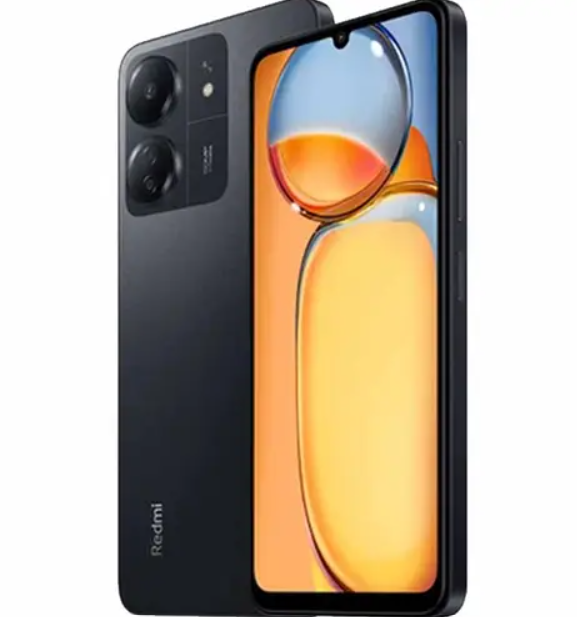
The Redmi 13C measures approximately 168 × 78 × 8.09mm and weighs about 192 grams according to Xiaomi’s specifications.
The large body accommodates the 6.74-inch display and 5000mAh battery while keeping the thickness around 8mm.
The phone is available in colors including:
- Midnight Black
- Navy Blue
- Glacier White
- Clover Green
Color availability can vary by market and seller.
The side-mounted fingerprint sensor provides another convenient way to unlock the device.
Redmi 13C Software
The Redmi 13C originally shipped with MIUI 14 based on Android 13, although the software experience can change over time through updates and regional availability.
MIUI provides features such as:
- Custom themes
- Gesture navigation
- App management
- Privacy controls
- Screen recording
- Reading mode
- Security tools
- Memory extension
- Customizable home screen
Software features and availability can vary according to software version and region.
Redmi 13C Audio Experience
The phone includes a 3.5mm headphone jack, which remains useful for buyers who use traditional wired earphones.
Bluetooth 5.3 is also supported for compatible wireless headphones, speakers and other accessories.
The Redmi 13C is therefore a practical option for users who do not want to rely entirely on wireless audio.
Redmi 13C vs Competitors
Before buying the Redmi 13C, it makes sense to compare it with phones in the same general budget range.
Redmi 13C vs Redmi 12
Choose the Redmi 13C if you want a straightforward budget Xiaomi phone with a large 90Hz display, Helio G85 processor and 5000mAh battery.
The Redmi 12 should be considered if its specific display, camera, charging and pricing combination gives you better value at the time of purchase.
Redmi 13C vs Samsung Galaxy A06
Samsung may appeal more to buyers who prioritize the Samsung brand and software ecosystem, while the Redmi 13C offers a strong combination of 90Hz display, expandable storage and Xiaomi’s budget hardware approach.
Redmi 13C vs Tecno/Infinix
Tecno and Infinix frequently compete aggressively in the Pakistani budget market.
Compare the actual current price, RAM/storage, display refresh rate, charging speed, processor and warranty before choosing.
What should you compare before buying?
| Feature | Why It Matters |
|---|---|
| Processor | Determines everyday speed and gaming capability |
| RAM | Helps multitasking |
| Storage | Determines how many apps and files you can keep |
| Display | Affects viewing and scrolling |
| Battery | Determines endurance |
| Charging | Determines how quickly you can recharge |
| Camera | Important for photos and social media |
| Warranty | Important for after-sales support |
| PTA status | Important for SIM/network usage |
Redmi 13C Alternatives in Pakistan
If the Redmi 13C does not meet your requirements, consider comparing it with smartphones from:
- Samsung
- Tecno
- Infinix
- Realme
- Other Redmi models
The best alternative depends on your budget and priorities.
Choose another phone if you need:
Better gaming: Look for a phone with a stronger chipset.
Better display: Consider an AMOLED model.
5G: Choose a confirmed 5G model instead of the standard Redmi 13C.
Faster charging: Look for phones supporting higher-wattage charging.
Better cameras: Consider a device with a larger main sensor, better image processing or optical stabilization.
Redmi 13C PTA and Buying Guide for Pakistan
Before purchasing a Redmi 13C in Pakistan, do not look at price alone.
Check these things:
1. Confirm the exact variant
Make sure the listing clearly states whether you are buying 4GB, 6GB or 8GB RAM and how much internal storage is included.
2. Check warranty
Ask whether the device carries official warranty or shop warranty.
3. Verify PTA status
If you are buying an imported or used phone, check its IMEI/PTA status before paying.
4. Check the box and accessories
Package contents can vary between markets, so confirm what charger and accessories are included.
5. Compare the final price
A cheaper phone without the expected warranty or accessories may not actually be the better deal.
Redmi 13C for Karachi Buyers
For buyers in Karachi, price differences can occur between online retailers and physical mobile markets depending on stock, warranty and seller margin.
Before purchasing, compare:
- Exact RAM/storage variant
- Official vs shop warranty
- PTA status
- Box condition
- Charger included
- Return policy
- Final delivered price
Do not choose a seller only because the advertised Redmi 13C price is lower.
Redmi 13C for Students
The Redmi 13C can make sense for students because its large display is useful for:
- Online classes
- YouTube lectures
- PDFs
- WhatsApp study groups
- Google searches
- Social media
- Video calls
- Notes and documents
The 5000mAh battery is also useful for students who spend long hours away from a charging point.
Redmi 13C for Social Media Users
If your main activities are Instagram, TikTok, Facebook, WhatsApp and YouTube, the Redmi 13C offers a practical combination of:
- Large display
- 90Hz refresh rate
- 50MP main camera
- 8MP selfie camera
- 5000mAh battery
- Expandable storage
For serious content creators, however, a more capable camera and processor would be a better long-term investment.
Redmi 13C for Gaming
The Redmi 13C is best viewed as a budget all-rounder rather than a gaming phone.
It can handle casual games comfortably and supports popular titles with appropriately adjusted graphics settings.
If gaming is your number-one priority, compare the Redmi 13C against phones using newer and more powerful chipsets before buying.
Redmi 13C Box Contents
Depending on the regional package, Xiaomi lists the following items:
- Redmi 13C
- Power adapter
- USB Type-C cable
- SIM eject tool
- Quick Start Guide
- Warranty card
- Safety information
Package contents can differ by region and sales channel. Xiaomi specifically notes that charger/package availability can vary.
Who Should Buy the Redmi 13C?
Redmi 13C is a good choice for:
- Students
- First-time smartphone buyers
- WhatsApp users
- Social media users
- YouTube viewers
- Casual gamers
- People who want a large screen
- Users who prioritize battery life
- Buyers who need expandable storage
Redmi 13C may not be ideal for:
- Heavy gamers
- 5G users
- AMOLED display enthusiasts
- Professional mobile photographers
- Users who need very fast charging
- Buyers looking for flagship-level performance
Redmi 13C: Final Verdict
The Redmi 13C remains a practical budget smartphone for buyers who care about everyday usability rather than premium features.
Its biggest advantages are the 6.74-inch 90Hz display, MediaTek Helio G85 processor, 50MP main camera, 5000mAh battery, expandable storage and 3.5mm headphone jack.
The biggest compromises are the 720p LCD display, 4G-only connectivity on the standard model, modest charging speed and entry-level gaming performance.
If your budget is limited and you primarily use WhatsApp, social media, YouTube, calls, browsing and casual games, the Redmi 13C can still make sense.
If your priority is 5G, AMOLED, high-end gaming or significantly faster charging, compare newer alternatives before making the final decision.
Before buying, always confirm the latest PriceTech price, RAM/storage variant, PTA status, warranty and included accessories.
Frequently Asked Questions
What is the Redmi 13C price in Pakistan?
The current PriceTech listing shown on this page is Rs. 29,499, while actual market prices vary according to RAM/storage configuration, warranty and retailer. Recent Pakistan listings have shown different prices for the 4GB and 6GB variants.
Is Redmi 13C worth buying in 2026?
It can be worth buying for users who want a large 90Hz screen, 5000mAh battery, expandable storage and everyday performance at a budget price. Buyers wanting 5G, AMOLED or high-end gaming should compare newer alternatives.
Is Redmi 13C 4G or 5G?
The standard Redmi 13C is a 4G LTE smartphone. It should not be confused with the separate Redmi 13C 5G model.
Does Redmi 13C have a 90Hz display?
Yes. The Redmi 13C has a 6.74-inch display with a refresh rate of up to 90Hz.
Does Redmi 13C have an AMOLED display?
No. The Redmi 13C uses an LCD display with 720 × 1600 resolution.
What processor does Redmi 13C use?
The Redmi 13C uses the MediaTek Helio G85 octa-core processor with a maximum CPU frequency of up to 2.0GHz.
How much RAM does Redmi 13C have?
Official configurations include 4GB + 128GB, 6GB + 128GB and 8GB + 256GB, although available configurations can differ by region.
Does Redmi 13C support a memory card?
Yes. The Redmi 13C supports expandable storage through microSD. Xiaomi advertises support for expansion up to 1TB.
Does Redmi 13C have a 50MP camera?
Yes. The phone has a 50MP primary rear camera along with a 2MP macro camera and an auxiliary lens.
How many megapixels is the Redmi 13C selfie camera?
The front-facing camera is 8MP and includes features such as HDR, Portrait mode, time-lapse and a soft-light ring.
Does Redmi 13C support fast charging?
Yes. It supports up to 18W PD charging. Xiaomi notes that the included adapter can be 10W depending on the package/region.
How big is the Redmi 13C battery?
The Redmi 13C has a 5000mAh typical-capacity battery.
Can Redmi 13C run PUBG Mobile?
Yes, PUBG Mobile can be played on the Redmi 13C, but users should use realistic graphics settings for the Helio G85 hardware. It is better suited to casual and moderate gaming than demanding high-end gaming.
Does Redmi 13C have a headphone jack?
Yes. It has a 3.5mm headphone jack.
Does Redmi 13C have USB Type-C?
Yes. The Redmi 13C uses USB Type-C for charging and data transfer.
Is Redmi 13C good for students?
Yes. Its large display, long-lasting battery, expandable storage and adequate everyday performance make it a practical option for students using online classes, WhatsApp, YouTube, browsing and educational applications.
Is Redmi 13C good for gaming?
It is suitable for casual and moderate gaming but is not designed as a high-performance gaming phone. Users who prioritize gaming should compare processor and GPU performance before buying.
Redmi 13C vs Redmi 12 — which is better?
The better choice depends on the current prices and your priorities. Compare the display, processor, camera, charging, storage and warranty rather than choosing only by model name.
Redmi 13C vs Samsung Galaxy A06 — which should I buy?
The Redmi 13C is attractive for buyers who value its 90Hz display, expandable storage and Xiaomi hardware features. Samsung may be more appealing to users who prioritize the Samsung ecosystem and brand experience. Compare the latest prices and configurations before buying.
Where can I buy Redmi 13C in Pakistan?
The phone is available through online and physical mobile retailers. Before purchasing, verify the exact RAM/storage variant, warranty, PTA status, accessories and return policy.
Final Buying Checklist
Before placing your Redmi 13C order, check:
- Exact RAM and storage
- Current selling price
- Official or shop warranty
- PTA status
- Box condition
- Charger included
- Return/replacement policy
- Seller reputation
- Color availability
Last reviewed: August 2026